Rachid Mekhloufi
Forward · 1936–
AS Saint-Étienne · FLN
Left Saint-Étienne at the peak of his career to join the FLN team. Later coached the national side.
"We played for a country that did not yet exist on any map."
ⵣ · A new wing of DZ Odyssey
From colonial resistance to World Cup history.
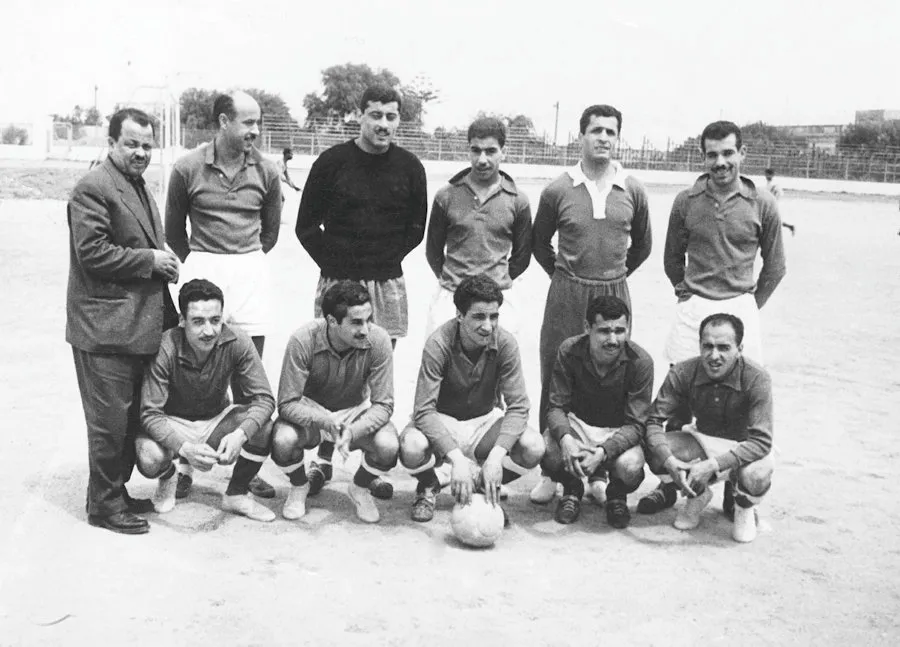
The team that carried Algeria's fight for independence onto the world's football stage.
Source: Algerian Football Federation (FAF)
Football, colonial rule, and quiet resistance
Football arrived in Algeria in the early 1900s carried by French settlers and sailors along the Mediterranean coast. Within two decades it had slipped its colonial frame, Muslim clubs stitched their own crests, their own colours, and their own quiet politics.
1962–1963 · a nation puts on its first jersey
In the year of independence, Algeria assembled its first officially sanctioned national team. The green-and-white took the pitch as a young republic still finding its borders on paper and its identity in front of a stadium full of witnesses.
Algeria becomes independent. A football federation is one of the first sporting bodies to be officially constituted.
The green-and-white play Bulgaria in Algiers. A modest scoreline, an enormous line to enter the stadium.
Algeria enters CAF competitions and begins the long apprenticeship that will lead to the 1980s.
Algeria enters World Cup qualifying for the first time. It will take another fourteen years to actually get there.
1958–1962 · the football team that fought for a country
In April 1958 nine professional players walked out of French clubs at the peak of their careers and boarded a train for Tunis. There, under the FLN’s green banner, they became a football team, a diplomatic mission and a moving symbol, all at once.
In four years the FLN team played close to eighty matches on four continents. FIFA refused to recognise any of them. Every player who left France sacrificed a European career at its peak, several never played professionally again. In 1963 they walked back into a free Algeria and became its first national team.
1958–1960
1982 · 1986 · 2010 · 2014 · 2026
Five appearances, one continent held in suspense. Algeria’s World Cup story runs from the shock of Gijón to the sixteenth minute of Porto Alegre, a full arc of ambition, heartbreak, and hard-won respect.
Brazil · Vahid Halilhodžić
Algeria’s finest World Cup. A 4–2 win over South Korea, a point against Russia, a knockout tie against Germany that ended in extra time, Porto Alegre knew it had seen a special side.
“Slimani rises in the 60th minute against Russia, Algeria are in the last sixteen for the first time.”
Brazil 2014 is the tournament in which Algeria finally translated a generation of French-Algerian talent into a coherent, aggressive side. Under Halilhodžić the Fennecs pressed high, scored seven goals, and, in a Porto Alegre knockout tie held to extra time, made the future world champions blink.
The African third round paired Algeria with Mali, Benin and Rwanda, six matches, sixteen points, group won. In the final playoff Burkina Faso struck first at home (2–3 in Ouagadougou) before Bougherra’s captain’s performance in Blida delivered a 1–0 win and qualification on away goals. Halilhodžić built the World Cup squad around that survival.
Group H opened in Belo Horizonte: Belgium’s Origi settled a 2–1 after Feghouli’s early penalty. Six days later, in Porto Alegre, Algeria produced the most complete performance of its World Cup history, Slimani, Halliche, Djabou and Brahimi punishing South Korea 4–2 inside 62 minutes. At the Arena da Baixada in Curitiba, Slimani’s header for 1–1 against Russia sent Les Fennecs into the knockout stage for the first time.
Porto Alegre, 30 June. For ninety minutes Algeria matched Germany blow for blow, M’Bolhi produced one of the great goalkeeping displays in World Cup history, and Halilhodžić’s counter-press disrupted Löw’s midfield. Schürrle broke the game in the 92nd minute of extra time; Özil doubled the lead; Djabou pulled one back in the last minute. Germany went on to win the World Cup, but Porto Alegre stood and applauded Algeria off the pitch.
A 4-2-3-1 built for transition. Two disciplined pivots (Medjani, Bentaleb) freed Feghouli, Brahimi and Djabou to run diagonally at defenders; Slimani held the line and finished. Halilhodžić’s pressing traps in midfield were the tournament’s most Algerian innovation.
Two goals, one assist, including the header against Russia that carried Algeria into the knockout stage.
Officially named FIFA’s Man of the Match against Germany. Twelve saves, most of them elite.
Scored against South Korea; his balance and left-foot delivery became Algeria’s attacking signature.
Wore the armband; retired from international football after the Germany match. His playoff-winning performance against Burkina Faso is what put Algeria on the plane.
Porto Alegre proved that Algerian football could be dominant, not merely resilient, on the world stage. The Halilhodžić blueprint, a disciplined block that could counter with genuine pace, became the tactical DNA of the 2019 AFCON-winning side.
25 June 1982 · why football finals now play simultaneously
On the final day of Group 2, West Germany and Austria knew exactly which scoreline would eliminate Algeria and played to it. The world watched a match without a contest. FIFA’s response would reshape every group stage that followed.
Same points as one qualifier. Better goal difference than one qualifier. Eliminated on goals scored.
Two stars · nineteen tournaments · one continental home
The Africa Cup of Nations is where Algeria plays as itself. From the golden generation of 1990 in Algiers to Belmadi’s champions in Cairo, the AFCON tells a longer, more familiar story than any World Cup ever could.
The players who wrote the anthem
A gallery of the players whose gestures, goals and gravity became national memory, from Mekhloufi’s exile to Mahrez’s corner-kick in Cotonou.
Left Saint-Étienne at the peak of his career to join the FLN team. Later coached the national side.
"We played for a country that did not yet exist on any map."
African Footballer of the Year 1981. Scored the winner against West Germany at the 1982 World Cup.
Backheel goal against Bayern in the 1987 European Cup final. Algerian icon abroad; national coach later.
Brace against Chile in 1982, the dancer of Gijón, before the shame.
Elegant creator of the late 70s and 80s national side.
PSG icon, first Algerian star of the French Ligue 1. Chose Algeria over France for the 1982 World Cup.
Goalkeeper of the 1982 World Cup side. Calm, tall, decisive.
Free-kick against Nigeria in the 2019 AFCON semi-final. Premier League title, Champions League title, and a second continental star.
All-time top scorer for Algeria. The header against Russia in 2014, the goals across every AFCON since.
Hat-trick against South Korea at the 2014 World Cup contributor. Dribbler, silent leader.
Scored Algeria’s first ever World Cup point (Mexico 1986, vs Northern Ireland).
Opened the scoring at Brazil 2014 against Belgium, quiet metronome of the 2019 champions.
The tacticians who shaped the green shirt
From Kermali’s calm continental blueprint to Belmadi’s unbeaten run, the men on the touchline have carried as much of the story as the men on the pitch.
Coached the 1990 AFCON winners at home. Quiet architect of the golden generation.
Five spells with the national team, spanning three World Cups and thirty years of Algerian football.
Bosnian tactician who forged the Brazil 2014 side, direct, physical, ruthless.
Player-turned-coach who ended a 29-year continental drought in Cairo and led a 35-match unbeaten run.
Belgian coach called twice to steady the ship after difficult periods.
Concrete cathedrals of Algerian football
Every anthem, every trophy lift, every last-minute equaliser is remembered by the stones that heard it first.
The national coliseum. Named after independence day. Home of every anthem that matters.
The fortress of the national team through the 2010s. Unbeaten for years.
A modern arena for a new decade. First national home built for the streaming era.
The eastern heart of Algerian football, home to CS Constantine.
The Mediterranean stadium built for the 2022 Games, Oran’s new pride.
Ninety minutes that changed a country
A handful of games that no Algerian will describe with statistics alone, the scoreline is always followed by where you were when it happened.
The upset that shook the World Cup. Madjer opened, Belloumi sealed. Rummenigge’s Germany humbled by a first-time African side.
Enter Match TheaterSalah Assad’s brace lifts Algeria to the edge of qualification, before Gijón takes it away.
A goalless night that sent Algeria to Italia 90 qualification territory and one of the most watched matches in the country’s history.
The most fluent Algerian performance ever seen at a World Cup. Slimani, Halliche, Djabou, Brahimi.
Ninety minutes of stalemate against the future World Champions. Djabou’s goal came too late, but Porto Alegre stood up.
Bounedjah’s deflected shot after 79 seconds. Twenty-nine years of drought end in Cairo.
Streets, chants, derbies, identity
In Algeria the game lives outside the stadium too, in the cracked concrete of Bab El-Oued, in Kabyle drums, in ultras chants that travel across the Mediterranean and come back as protest anthems.
The narrow alleys of Bab El-Oued, El Harrach and Belcourt where every Algerian footballer’s first move was invented.
MCA vs USMA in Algiers, MCO vs ASMO in Oran, JSK vs USMA nationwide, each match carries its own century.
‘La Casa d’el Mouradia’, born on the terraces, became a soundtrack of the 2019 Hirak movement.
Green shirts in diaspora cafés, radios turned up in olive groves, the day after big matches often quieter than the match itself.
Silver, bronze, and the weight of continents
Hover a plaque to hear its story. Every trophy in this room was won under a different generation’s pressure and remembered by all of them.
The numbers behind the anthem
Appearances, goals, qualification runs, the quiet ledger of a national side told in figures.
Jerseys, tickets, and things that survived the match
The small artifacts that never make the highlights reel, but that families kept in a drawer for forty years anyway.
Green shirt with a modest white collar. Le Coq Sportif.
Algiers, 16 March 1990. General admission, 5 dinars.
Worn during the header against Russia.
Awarded in Cairo, 19 July 2019.
Nine men, one shirt, a country still to come.
Brazuca, Porto Alegre.
Line-ups, coach interviews, and the anthem lyrics printed in three languages.
Scroll a century of Algerian football
One horizontal ribbon. Every era, tournament and figure in this hall placed where it belongs in the story.
Explore the rise of Algeria's women's national team, a full exhibit of its own.
Traceable citations, curator notes and further reading.
Match results, squads and tournament records are cross-checked against FIFA, CAF, the Algerian FA (FAF) and RSSSF.