
ⵣ · Permanent exhibit · Sahara
Tassili n'Ajjer
The Sahara, before it was a desert.
On a sandstone plateau in the far south-east of Algeria, people painted and carved for roughly twelve thousand years. They drew elephants, hippopotamus, giraffe, cattle herds, dancers, chariots and finally camels. Read in order, those images are the record of a green land drying out, and of the human beings who kept living on it as it changed.
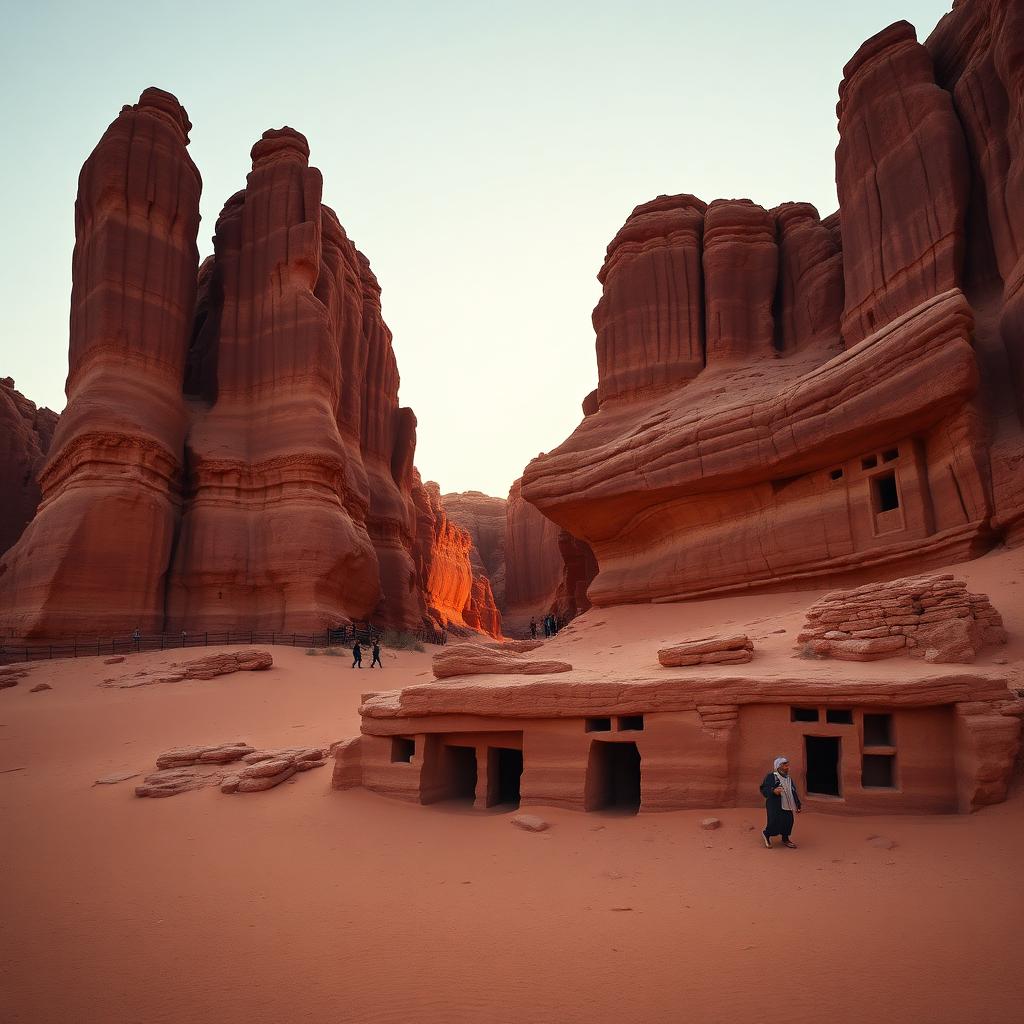
Illustration created for DZ Odyssey. Not a historical photograph.
ⵣ · Where
A plateau the size of a country
Tassili n'Ajjer lies in the wilaya of Illizi, in the far south-east of Algeria, reaching toward the borders with Libya and Niger. Djanet is the gateway town. The name comes from Tamazight and is usually rendered as the plateau of the rivers, a description that made plain sense when the rivers were still running.
Museum data card · Tassili n'Ajjer
- Wilaya
- Illizi
- Protected area
- about 72,000 km²
- Highest point
- Adrar Afao, 2,158 m
- Recorded images
- more than 15,000
- Oldest works
- about 12,000 years
- Inscribed
- UNESCO, 1982
The property is one of the largest World Heritage sites on earth. Walking across it takes days, and most of it has never been surveyed in detail.
ⵣ · The rock
A forest made of stone
Wind and long-vanished water have cut the sandstone into columns, corridors and arches, an eroded landscape often called a rock forest. Several hundred natural arches have been counted. The same erosion that carved these shapes also produced sheltered overhangs and shallow caves, and those shelters are where almost all of the art is found.
The plateau also shelters living relics of the wetter Sahara. Small stands of the endemic Saharan cypress, Cupressus dupreziana, survive here, some of them well over a thousand years old and unable to regenerate in the present climate. They are, in a sense, another kind of record of the same change.
- The plateau is also a UNESCO biosphere reserve, recognised in 1986.
- Its wetlands were listed under the Ramsar Convention in 2001.
- The Kel Ajjer Tuareg have lived with and around the plateau for centuries and remain its principal guides.
Illustration created for DZ Odyssey. Not a historical photograph.
ⵣ · The painted sequence
Five ages on one wall
Scholars group the art of Tassili into broad stylistic phases. The boundaries between them are debated and the dates are approximate, but the order is not seriously in question, because each phase brings animals that need less water than the last.
01 · Earliest phase
Large wild fauna
Deeply cut engravings of elephant, rhinoceros, hippopotamus and the extinct giant buffalo, animals that require standing water and grassland. This is the Sahara of lakes and rivers, and the images are the strongest evidence that it existed.
Did you know · The extinct buffalo Syncerus antiquus gives this phase its older scholarly name, the Bubalus period.
02 · A distinct painted tradition
Round Head paintings
Large human figures with featureless rounded heads, sometimes several metres tall, often floating or masked. The style is unlike anything around it and its meaning is genuinely unresolved. Interpretations range from ritual and masking to ancestor imagery, and none of them is settled.
Did you know · Popular claims that these figures depict visitors from elsewhere have no archaeological basis.
03 · Cattle herders
The pastoral period
The largest and most detailed body of work. Herds of long-horned cattle, camps, milking scenes, women grinding grain, children, dogs, dances and negotiations. This is domestic life recorded from the inside, by people who had time and reason to record it.
Did you know · Individual animals are painted with distinct coat patterns, as if particular cows were being portrayed.
04 · Chariots and speed
The horse period
Horses arrive, and with them light two-wheeled chariots, drawn in a flying-gallop convention. The landscape is drying, the cattle thin out, and the images turn toward movement, weapons and long-distance travel across a hardening land.
05 · The desert arrives
The camel period
The camel appears late, and once it does the Sahara as we know it has arrived. The paintings become sparser and more schematic, and Tifinagh inscriptions begin to appear beside them, linking the plateau directly to the Amazigh writing still used by Tuareg communities today.
Did you know · Tifinagh at Tassili is a living thread, not a dead one. The script is still written in the Algerian Sahara.
ⵣ · Reading the images
An archive of a changing climate
Set the periods side by side and a sequence appears: hippopotamus, then cattle, then horses, then camels. Each animal needs less water than the one before it. The art is not a picture gallery, it is a long environmental record kept by the people who lived through the change, one wall at a time.
Dating remains difficult and debated. Styles overlap, walls were reused, and pigment on open rock rarely yields a clean date. Most chronologies here are relative sequences supported by subject matter and technique rather than fixed calendar years, and the museum states them as such.
Figures given for the number of images and for the age of the oldest works are estimates drawn from published survey work. They should be read as orders of magnitude, not counts.
ⵣ · How the world found out
The expeditions, and their footnote
Tuareg communities knew these shelters for generations. Wider attention came through survey work in the 1930s and above all through the expedition led by Henri Lhote in 1956 and 1957, which produced hundreds of full-size copies and made Tassili famous well beyond Algeria.
That work carries a caution. Copyists sometimes wetted the walls to raise the colours, and some reproductions were completed or sharpened by hand. A few of the most widely circulated images owe part of their drama to the copy rather than the original. The exhibit reports the finds and the caveat together, because both are part of the record.
The plateau was never lost. It was only unvisited by the people who later announced they had found it.
ⵣ · World Heritage
A mixed site, inscribed in 1982
Tassili n'Ajjer is inscribed for both its culture and its natural landscape, one of the relatively few mixed properties on the World Heritage List. The rock art and the eroded plateau that shelters it are protected as a single thing, because neither makes sense without the other.
Criteria of inscription
The paintings and engravings are recognised as a masterpiece of human creative genius.
They bear exceptional testimony to prehistoric Saharan societies and to their disappearance as the climate changed.
The eroded sandstone landscape, with its pillars and natural arches, is of outstanding natural beauty.
The formations record major stages of the earth's history and ongoing geomorphic processes in an arid environment.
What is protected
The rock art shelters, the sandstone landforms, the relict cypress stands, the wetlands and gueltas, and the cultural landscape of the Kel Ajjer who live with them.
The pressures
Pigment fades under sun and wind-blown sand. Touching, wetting and graffiti cause direct loss, and vehicle tracks damage fragile ground. Access is regulated and accompanied, and photography without flash is the standard rule.
ⵣ · Why it matters
The longest story Algeria tells
Every other exhibit in this museum covers centuries. Tassili covers millennia. It pushes the human history of Algeria back past kingdoms, past writing, past agriculture in this region, to people who painted what they saw because they wanted it kept.
It also matters now. A record of a fertile land becoming a desert, written by the people it happened to, is not only an ancient document. It is the closest thing we have to a first-hand account of climate change, and it is Algerian.
ⵣ · Did you know?
Six things about the plateau
Tassili n'Ajjer is one of the largest protected areas in the world, roughly the size of Ireland and Belgium combined.
The Saharan cypress that grows here exists nowhere else on earth, and only a few hundred mature trees remain.
Some shelters carry paintings from several different periods on the same wall, thousands of years apart.
Chariots drawn in a flying gallop appear here, a convention also known from the Mediterranean world.
Tifinagh inscriptions on the rock connect the plateau to an Amazigh script that is still written today.
The oldest images here predate the pyramids of Giza by roughly seven thousand years.
ⵣ · Museum collection
Plates
The rock art of Tassili is protected, and DZ Odyssey holds no rights-cleared photographs of the shelters. The plates below are interpretive illustrations of the landscape and the environment, clearly labelled as such. Full provenance is listed at the end of the exhibit.
Plate 01
Tassili n'Ajjer · the rock forest
Interpretive illustration produced for DZ Odyssey. Not a documentary photograph of a specific shelter.
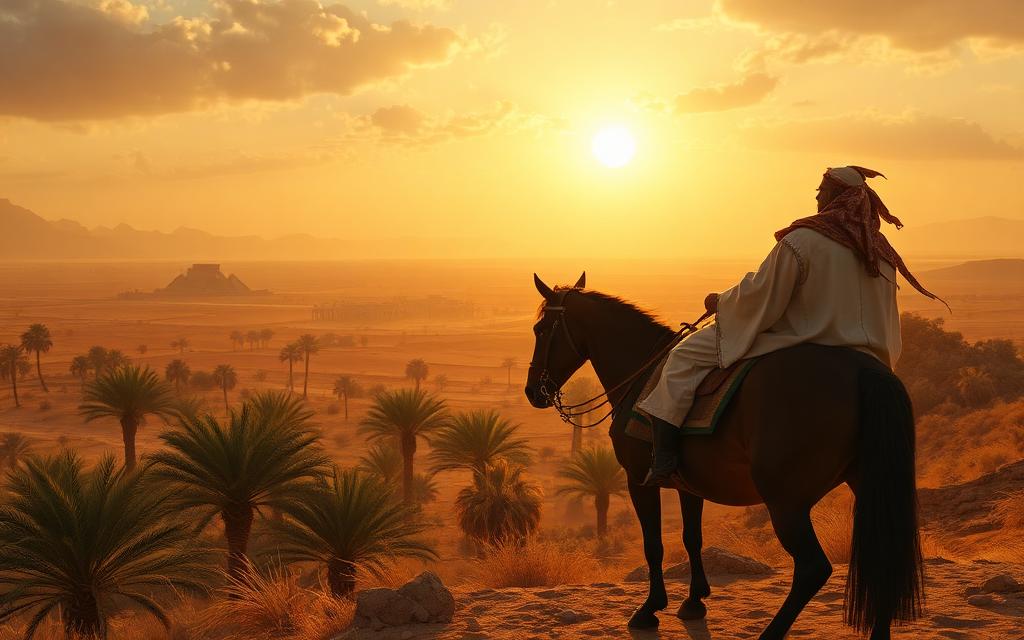
Plate 02
Early North Africa · the green Sahara
Interpretive illustration produced for DZ Odyssey, showing the wetter environment the earliest images record.
ⵣ · A living Saharan heritage
The Tuareg of the Algerian Sahara
The Tuareg are Amazigh-speaking peoples whose communities extend across the central Sahara. In Algeria, Tuareg life is especially associated with the Ahaggar around Tamanrasset and the Ajjer country around Djanet and Tassili n'Ajjer. Their history cannot be reduced to a single image of nomadic life. Tuareg communities include mobile pastoralists and settled families, and their cultural knowledge continues through language, music, ceremony, craftsmanship and relationships with the desert landscape.
01 · Cultural areas
Ahaggar and Ajjer
In southern Algeria, two major Tuareg cultural areas are associated with the Ahaggar massif and the Tassili n'Ajjer region. The Kel Ahaggar are closely connected with the country around Tamanrasset, while the Kel Ajjer are associated with Djanet, Tassili and neighboring Saharan territories. These names describe historical and cultural affiliations, not fixed modern borders.
02 · Language and script
Tamahaq and Tifinagh
Many Tuareg communities in Algeria speak varieties of Tamahaq, part of the Amazigh language family. Tifinagh writing is an important expression of Tuareg and wider Amazigh cultural identity. Language use varies by community, generation and setting, and Arabic and French are also part of contemporary life.
03 · Music
Imzad
The imzad is a single-stringed bowed instrument traditionally played by Tuareg women. Its music accompanies poetry and gatherings and is transmitted through listening, observation and practice. UNESCO inscribed the practices and knowledge associated with the imzad in 2013.
04 · Ceremony
Sebeïba in Djanet
The Sebeïba ritual and ceremonies take place in the oasis of Djanet. Music, dance, dress and craftsmanship bring participating communities together and reinforce social ties. UNESCO inscribed Sebeïba on the Representative List of the Intangible Cultural Heritage of Humanity in 2014.
Provenance & Sources
Traceable citations, curator notes and further reading.
Widely Accepted
Provenance & Sources
Traceable citations, curator notes and further reading.
The exhibit follows the UNESCO World Heritage record for Tassili n'Ajjer. Dates and image counts are published estimates, and the stylistic phases are relative sequences rather than fixed calendar periods.
Museum Collections
- The MetThe Metropolitan Museum of Art
International Organizations
- UNESCO
- UNESCO
- UNESCOUNESCO Intangible Cultural Heritage
- UNESCOUNESCO Intangible Cultural Heritage